
WELCOME BONUS 300%
UP TO €2000 + 100
FREE SPINS
UP TO €2000 + 100
FREE SPINS
Home → Games
Casino games at Christchurch Casino
Doubling Down: Twice the Stake, One More Card
A double down lets a player double the original stake and then receive exactly one more card, and under the six-deck rule set it is allowed on any first two cards with the dealer standing on soft 17. That combination of S17 and doubling on any two cards supports an RTP of 99.54% with basic strategy, so 100 € of stakes costs about 0.46 € on average.
Doubling after a split is also permitted in this variant, which keeps the house edge at 0.46% instead of the higher figure that a no-DAS rule would produce. Late surrender works differently: the player gives up the hand after the dealer checks for blackjack and loses half the stake, a rule worth about 0.08 percentage points of RTP. On a 100 € bet that surrender returns 50 €.
Insurance is the side bet to decline, because the separate wager of up to 50% of the main bet pays 2:1 and carries an RTP of 92.53% across six to eight decks. Basic strategy always turns it down, except for card counters at a true count of at least +3. That 7.47% house edge is far above the 0.46% of the main game.
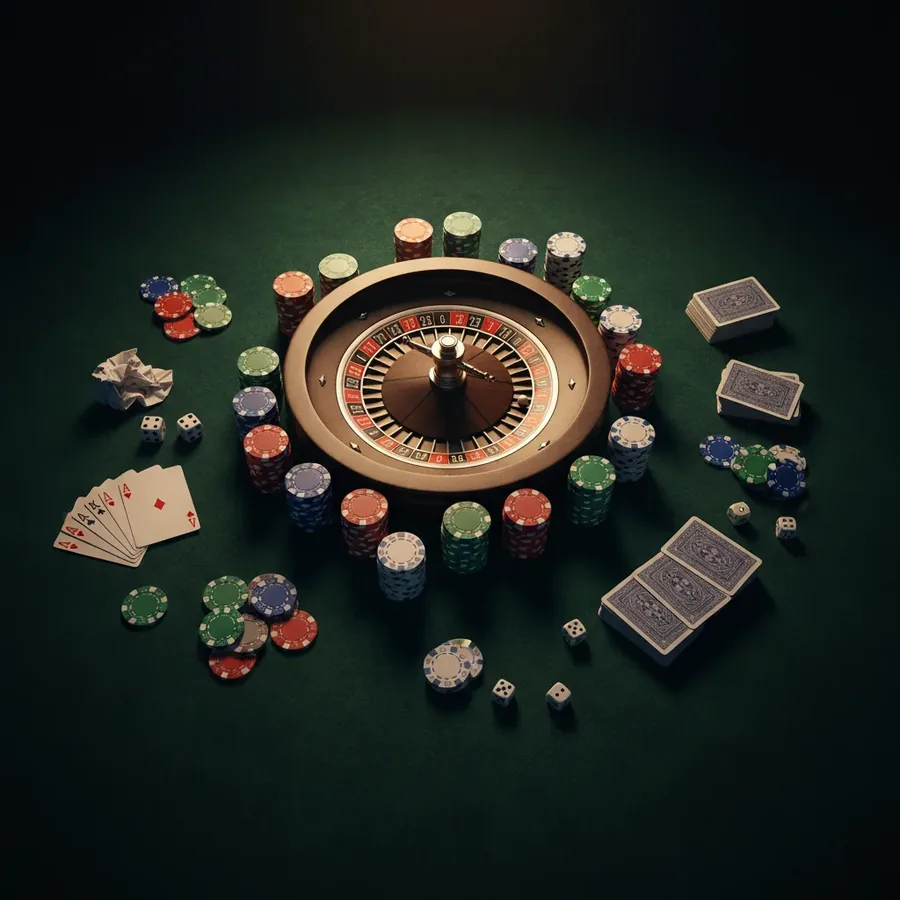
Variance at the Table: 1:1 vs 35:1
Even-money bets pay 1:1 on Red/Black, Odd/Even and Low/High, so a 10 € stake returns 10 € of profit when the bet wins. Inside bets pay far more: a Straight pays 35:1, a Split 17:1, a Street 11:1 and a Corner 8:1. The same 10 € on a single number would return 350 €, but the odds of hitting it are much longer.
On the French wheel with La Partage, the even-money bets reach an RTP of 98.65% and a house edge of 1.35%, because half the stake comes back when 0 hits. Inside bets are not covered by La Partage, so they stay at 97.30% and a 2.70% edge. That gap means 100 € staked on Red/Black costs 1.35 € on average, while the same 100 € on a Straight costs 2.70 €.
Craps shows the same split in a different form. The Don't Pass bet returns 98.64% with a house edge of 1.36%, slightly better than the Pass Line at 98.59%, because 7 wins and 12 is a push. The Baccarat Tie bet at 8:1 is the outlier, with an RTP of 85.64% and a house edge of 14.36%, nearly three times the 4.84% edge of the 9:1 version.
Video Poker: Check the Paytable Before You Bet
A video poker payout table is the list of returns for each winning hand, and in Jacks or Better 9/6 the Full House pays 9 and the Flush pays 6 per coin. Those two figures lift the game to an RTP of 99.54% and a house edge of 0.46% under optimal strategy. The Royal Flush pays 800 per coin, or 4,000 coins on the maximum bet of 5 coins.
The short pay table 8/5 pays a Full House 8 and a Flush 5, which lowers the RTP to 97.29% and raises the house edge to 2.71%. That two-unit cut costs 2.25 percentage points against 9/6. Other versions sit in between: 9/5 returns 98.45% and 8/6 returns 98.39%, while 7/5 drops to 96.15% and 6/5 to 94.99%, so the table matters more than the game name.
Deuces Wild adds wild cards to the same logic. The Full Pay version pays Four Deuces 200 and a Wild Royal 25, and reaches an RTP of 100.76% with flawless optimal strategy and the maximum bet. The Not So Ugly Ducks table, with Five of a Kind 16 and a Straight Flush 10, returns 99.73%. Illinois Deuces sits at 98.91%.
Game Shows: Sectors, Multipliers and Bet Ranges
Live game shows build each round around a spinning wheel divided into sectors, and a multiplier attached to a sector decides how much a winning bet returns. A multiplier of x5000 turns a 1 € stake into 5,000 €, while smaller sectors may carry x2 or x5. The RTP of such a round depends on how the sectors and multipliers are weighted across the wheel.
Bet ranges on these shows usually start at a low minimum and run to a much higher maximum, and the spread between the two ends decides how long a bankroll lasts. A player staking the minimum keeps a balance for many more rounds than one staking the maximum. The same principle applies to the welcome offer: a 300% bonus up to €2,000 plus 100 free spins on a €50 deposit gives 50 € x 300% = 150 € bonus, so 50 € + 150 € = 200 € of balance.
Side bets also appear in show formats, and these optional wagers next to the main bet carry their own multipliers and their own RTP. A side bet can pay far more than the main wager but also carries a much larger house edge. Checking the multiplier attached to each sector before staking keeps the round's cost per spin visible.
Game categories at a glance
| Category | Examples | Stakes From | Highlight |
|---|---|---|---|
| Slots | Sticky Bandits Trail of Blood, Esqueleto Explosivo 2, Nitropolis 4 | 0.10 EUR | thousands of titles |
| Table games | Roulette, Blackjack, Baccarat | 0.50 EUR | classic rules |
| Live casino | Blaze Roulette, Crazy Time | 0.20 EUR | real dealers |
| Jackpot games | Mega Moolah, Divine Fortune, Age of the Gods | 0.20 EUR | progressive pools |
| Instant games | Aviator, Plinko, Mines | 0.10 EUR | fast rounds |
| Video poker | Jacks or Better, Deuces Wild | 0.25 EUR | strategy based |
Video Poker 9/6: What the Two Numbers Mean
Video Poker Jacks or Better 9/6 carries an RTP of 99.54% with optimal strategy, which leaves a house edge of just 0.46%. The two numbers refer to the payout for a Full House and a Flush per single coin: a Full House pays 9 coins and a Flush pays 6 coins. That small difference against an 8/5 table is worth 2.25 percentage points of RTP, because the 8/5 version returns only 97.29%. For every 100 € staked on the full pay table, the average cost is 0.46 € instead of 2.71 €.
The Royal Flush bonus of 4,000 coins requires the maximum bet of 5 coins, while a one-coin Royal Flush pays 800. A Straight Flush pays 50, Four of a Kind 25, Full House 9, Flush 6, Straight 4, Three of a Kind 3, Two Pair 2, and Jacks or Better 1. The standard deviation of the full pay game is 4.42, which means results can swing widely from session to session. A player who bets less than five coins gives up part of the long-term return.
The intermediate tables show exactly how the two numbers move: 9/5 returns 98.45%, 8/6 returns 98.39%, 7/5 returns 96.15%, and 6/5 returns 94.99%. The 9/6 version is therefore the benchmark, and every missing payout unit on the Full House or Flush costs real money over hundreds of thousands of hands. RTP is a theoretical long-run average, never a forecast for one session.
Split 17:1 vs Corner 8:1: Payouts Compared
A Split bet in French Roulette pays 17:1 and covers two adjacent numbers on the 37-pocket wheel. The house edge on inside bets is 2.70%, because La Partage does not apply to inside bets. For every 100 € staked on a Split, the average cost is 2.70 €. A winning 10 € Split returns 170 € in winnings plus the original 10 € stake. The same 17:1 payout applies on the American wheel, but there the house edge doubles.
A Corner bet covers four numbers and pays 8:1 in both French and American Roulette. On the European wheel with 37 pockets the return is 97.30%, while on the American wheel with 38 pockets the return falls to 94.74%. The extra double-zero pocket raises the house edge from 2.70% to 5.26%. For a beginner, the Corner bet looks similar on both wheels, but the long-run cost is almost twice as high on the American version.
The payout ladder on inside bets runs from Straight 35:1, Split 17:1, Street 11:1, Corner 8:1, Six Line 5:1, up to Dozen 2:1 and Column 2:1. La Partage and En Prison reduce the edge only on even-money bets such as Red/Black, Odd/Even and Low/High, where the return improves to 98.65% and the edge drops to 1.35%. Inside bets keep the European-level edge of 2.70% even on a French table.
Splitting in Blackjack: One Hand Becomes Two
Splitting in Blackjack turns one hand into two separate hands when the first two cards have the same value. The player places an additional stake equal to the original bet and each new hand is played independently. In the six-deck game with S17, DAS, DOA, 3:2 payout and basic strategy, the RTP is 99.54% and the house edge is 0.46%. Doubling after a split is allowed in that rule set, which is a meaningful player advantage.
The single-deck classic game with 3:2 payouts offers an RTP of 99.85% and a house edge of only 0.15%. Fewer decks lower the edge, and one deck gives about −0.48 percentage points compared with eight decks. That advantage is often offset by a 6:5 payout on blackjack, which is a separate rule change and not part of the classic 3:2 game. Splitting decisions change the total amount at risk, because each split hand carries its own stake.
Late surrender is a separate rule that improves RTP by about 0.08 percentage points. The player gives up the hand after the dealer has checked for blackjack and loses half the stake, so 50% of the stake is returned. Early surrender is worth much more, up to −0.6 percentage points, but is extremely rare. Splitting and surrender are independent decisions, and basic strategy treats each hand on its own numbers.
How a Blackjack Hand Plays Out: Cards, Decisions, 3:2 Payout
A Blackjack round starts with two cards dealt to the player and two to the dealer, with one dealer card face up. The player then decides whether to hit, stand, double down or split, depending on the hand and the dealer's upcard. The dealer stands on soft 17, and doubling after a split is allowed.
A natural Blackjack pays 3:2, so a 10 € stake wins 15 €. A regular win pays 1:1. The single-deck classic game with 3:2 payouts returns 99.85% and carries a house edge of just 0.15%. The extra half-unit on a natural Blackjack is the key reason a 3:2 table is far better than a 6:5 table. On a 6:5 table the same 10 € natural returns only 12 €, and the long-run cost rises sharply.
Insurance is a separate side bet of up to 50% of the main bet when the dealer shows an ace. In a six- to eight-deck game it carries an RTP of 92.53% and a house edge of 7.47%. Basic strategy always declines insurance, except for card counters at a true count of +3 or higher. With a single deck the edge is about 5.88%. The main flow of the round never requires the insurance bet.
House Edge and RTP: Two Sides of the Same Number
The house edge is the average share of each stake that the casino keeps over the long run, so a game with a house edge of 0.46% keeps 0.46 cents of every euro staked. Its mirror image is RTP, the return to player, which for the same game stands at 99.54%. Adding the two figures always gives 100%, because every euro staked is split between what players get back and what the casino retains. For someone staking €100, that 0.46% edge costs about €0.46 on average.
The spread between games is wide. Craps Don't Pass carries a house edge of 1.36% and an RTP of 98.64%, while Roulette American, with its double zero and 38 pockets, sits at 5.26% and 94.74%. Baccarat Tie at 8:1 is the weakest main bet on the board: 14.36% edge and 85.64% RTP. That is roughly ten times the craps figure. RTP is a theoretical long-run average over hundreds of thousands of spins, never a forecast for a single session.
Rule variations move the number without changing the game's name. Blackjack single deck with classic rules and a 3:2 payout reaches 99.85% RTP and a 0.15% edge, while the six-deck version at 99.54% and 0.46% gives up about 0.31 percentage points. Late surrender improves a blackjack game by around 0.08 percentage points, because the player gives up the hand after the dealer has checked for blackjack and loses half the stake.
Taking Insurance: The Most Common Blackjack Mistake
Insurance is a side bet of up to 50% of the main bet, offered when the dealer shows an ace and paid at 2:1. A side bet is an optional extra wager placed next to the main bet. Across six to eight decks, insurance returns 92.53% RTP and carries a house edge of 7.47%. That edge is more than sixteen times the 0.46% edge of a six-deck blackjack game played with basic strategy.
Basic strategy always declines insurance, except for card counters who act at a true count of +3 or higher. On a single deck the edge is about 5.88%, noticeably better than the multi-deck figure but still far above the main game. For a player staking €100 on insurance across many hands, the average cost is €7.47, compared with €0.46 on the underlying hand.
The step-by-step rule is simple: the dealer shows an ace, the insurance offer appears, and the default answer is no. The 2:1 payout looks generous, but the odds of the dealer holding a ten are not high enough to justify it. Only a counted shoe changes that arithmetic, and only at a true count of +3 or above.
Craps Pass Line: 1.41% House Edge
The Pass Line bet in craps returns 98.59% RTP and carries a house edge of 1.41% per resolved bet, which works out to 0.42% per roll. The payout is 1:1. Staking €100 on Pass Line across many resolved bets costs about €1.41 on average, one of the lowest figures among the main table bets. Standard deviation is 1.00.
The Come bet uses identical maths to Pass Line: 98.59% RTP, 1.41% edge, 0.42% per roll. The Don't Pass bet is slightly better at 98.64% RTP and 1.36% edge, because 7 wins and 12 is a push, sometimes 2. Per roll the Don't Pass edge is 0.40%. The gap between the two is 0.05 percentage points.
The step-by-step picture is straightforward. The come-out roll establishes a point or resolves the bet, then each subsequent roll either repeats the point or ends the hand. Per-roll cost is lower than per-bet cost because a single resolved bet can span several rolls. Don't Come mirrors Don't Pass, paying 1:1 and pushing on 12.
Punto Banco: 5% Commission on Banker Wins
Punto Banco is played with a Banker bet and a Player bet, and a Tie bet as a third option. The Tie bet at 8:1 returns 85.64% RTP with a house edge of 14.36%, the worst main bet in the game. Standard deviation for the Tie bet is 2.64. The Banker bet carries a 5% commission on wins.
The Tie bet at 9:1, more common online, cuts the edge from 14.36% almost threefold to 4.84%, and lifts RTP to 95.16%. Even then it remains clearly worse than Banker or Player. For €100 staked on the 9:1 Tie, the average cost is €4.84, against €14.36 on the 8:1 version. The gap between the two Tie payouts is 9.52 percentage points of RTP.
The step-by-step choice is therefore narrow. Banker and Player are the main bets, the Tie is the side option, and the commission applies only to Banker wins. Players comparing the two Tie payouts should note that both sit well below the main bets, so the payout improvement softens the edge without removing it.
Straight-Up, Split and Corner Compared
On the European wheel with 37 pockets, inside bets pay Straight 35:1, Split 17:1, Street 11:1 and Corner 8:1. Roulette French inside bets return 97.30% RTP with a house edge of 2.70%, because La Partage and En Prison apply only to even-money bets and leave the inside bets at the European level. Staking €100 across inside bets costs about €2.70 on average.
The American wheel changes the picture. With 38 pockets, 1 to 36 plus 0 and 00, the same payouts apply but RTP drops to 94.74% and the house edge doubles to 5.26%. The extra pocket is the whole difference. For €100 staked on a Straight bet, the average cost rises from €2.70 to €5.26, a gap of 2.56 percentage points.
French even-money bets behave differently. With La Partage, when 0 hits, half the stake on Red/Black, Odd/Even or Low/High is returned, giving 98.65% RTP and a 1.35% edge. En Prison produces the same 1.35%. The step-by-step rule: inside bets keep the 2.70% edge, and only the even-money bets benefit from the 0 refund.
Contact
Live - online chat
Banking









Providers












Christchurch Casino 2026